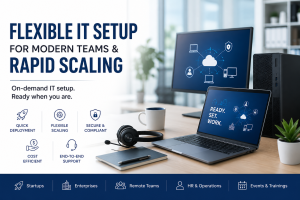
Work culture has evolved far beyond the traditional office setup. While remote work initially gained traction, businesses are now realizing that location is only one part of the equation. What truly enables efficiency today is a flexible IT setup that adapts to changing workforce demands.
Companies are no longer asking, “Where will employees work?” Instead, they are asking, “How quickly can we enable them to work?”
This shift is driving the demand for infrastructure that is agile, scalable, and ready to deploy—without heavy upfront investments.
Why Static IT Infrastructure No Longer Works
Traditional IT procurement models were built for stability, not speed. However, modern businesses operate in environments where:
- Hiring happens in weeks, not months
- Teams expand and contract dynamically
- Projects require short-term specialized setups
- Budget allocation is closely monitored
As a result, fixed infrastructure becomes a bottleneck. It slows onboarding, increases capital expenditure, and limits adaptability.
In contrast, a flexible IT setup allows organizations to align technology with real-time needs instead of long-term assumptions.
Flexible IT Setup as a Growth Enabler
Growth-stage companies often face a common challenge: scaling operations without overspending. This is where flexibility in IT becomes a strategic advantage.
A well-implemented flexible IT setup enables:
- Instant provisioning of devices for new hires
- Easy upgrades or downgrades based on project needs
- Reduced dependency on long procurement cycles
- Better cash flow management by shifting from CAPEX to OPEX
Moreover, startups and scaling companies can maintain operational momentum without worrying about infrastructure delays.
On-Demand IT Setup for Instant Deployment

Speed is no longer optional—it is expected. Businesses that can deploy systems quickly gain a competitive edge.
An on-demand IT setup supports this by offering:
- Pre-configured laptops, desktops, and workstations
- Bulk deployment for teams across multiple locations
- Standardized configurations for consistency
- Rapid replacement and support when needed
For example, onboarding 50 employees within a week becomes feasible when infrastructure is ready to deploy rather than being built from scratch.
Flexible IT Setup for Distributed and Hybrid Teams
As organizations embrace hybrid models, managing distributed teams becomes more complex. Employees work from different cities, sometimes even different countries.
A flexible IT setup ensures that:
- Every team member receives standardized systems
- Security and compliance protocols remain intact
- IT support can be centralized despite geographic spread
- Device lifecycle management is streamlined
Consequently, businesses maintain control while offering flexibility to their workforce.
Supporting HR and Operations with Plug-and-Play Systems

HR and operations teams often face the pressure of seamless onboarding. Delays in providing systems directly impact employee productivity and first impressions.
With a structured flexible IT setup, onboarding becomes efficient:
- Devices are delivered ready-to-use
- Required software and security tools are pre-installed
- Minimal IT intervention is needed during setup
- Employees can start working from day one
This not only improves productivity but also enhances the overall employee experience.
Event and Training Infrastructure Without Ownership Burden
Short-term requirements present a unique challenge. Event companies, training providers, and corporate workshops often need infrastructure for limited durations.
Instead of investing in assets that may remain unused later, businesses rely on an on-demand IT setup to:
- Access bulk systems for specific durations
- Scale up or down based on event size
- Avoid storage and maintenance concerns
- Ensure high-performance systems for specialized tasks
Therefore, flexibility reduces both operational complexity and financial risk.
Cost Efficiency Through Flexible IT Setup

Cost optimization remains a priority across industries. Traditional IT investments require significant upfront capital, which may not always align with business cycles.
A flexible IT setup transforms cost structures by:
- Eliminating large initial investments
- Allowing predictable monthly expenses
- Reducing maintenance and upgrade costs
- Minimizing asset depreciation risks
As a result, businesses can allocate resources more strategically while maintaining technological efficiency.
Standardization and Compliance Made Simpler
Corporate IT heads often prioritize security, compliance, and standardization. Managing these aspects across multiple locations can be challenging.
However, a flexible IT setup simplifies this by ensuring:
- Uniform device configurations across teams
- Centralized control over security policies
- Easy tracking and monitoring of assets
- Compliance with organizational standards
This balance between flexibility and control is essential for enterprise-level operations.
Future-Ready Businesses Rely on Flexible Infrastructure
The future of work is defined by adaptability. Companies that invest in rigid systems may struggle to keep up with changing demands.
On the other hand, businesses adopting a flexible IT setup position themselves for:
- Faster response to market changes
- Seamless scaling during growth phases
- Efficient handling of remote and hybrid teams
- Improved operational resilience
Thus, infrastructure becomes a strategic asset rather than a limitation.
Related Queries and Practical Insights
How does a flexible IT setup improve onboarding speed?
A flexible IT setup ensures that devices are pre-configured and ready for immediate use. Instead of waiting for procurement, installation, and setup, employees receive systems that are already optimized for their roles. This reduces onboarding time significantly and allows teams to start contributing from day one.
What is the difference between traditional IT procurement and on-demand IT setup?
Traditional IT procurement involves purchasing hardware, managing inventory, and handling maintenance internally. This process is often time-consuming and capital-intensive.
In contrast, an on-demand IT setup provides ready-to-use infrastructure when required, without ownership. Businesses can scale resources up or down based on needs, making it more efficient and flexible.
Is flexible IT setup suitable for large enterprises?
Yes, large enterprises benefit significantly from a flexible IT setup. It helps manage distributed teams, ensures standardization, and simplifies compliance. Additionally, it allows enterprises to handle large-scale deployments and upgrades without disrupting operations.
How does flexible IT setup reduce overall IT costs?
Instead of investing heavily in hardware upfront, businesses pay for what they use. This shifts expenses from capital expenditure to operational expenditure. Furthermore, maintenance, upgrades, and replacements are typically included, reducing unexpected costs.
Where can businesses get reliable flexible IT setup solutions?
Businesses looking for scalable and dependable solutions can explore providers like IndiaRENTALZ. They offer end-to-end rental solutions, including laptops, desktops, and high-performance systems, along with delivery, support, and lifecycle management.
This approach ensures that companies can focus on operations while the infrastructure is handled seamlessly.
Can on-demand IT setup support short-term projects effectively?
Yes, on-demand IT setup is particularly useful for short-term requirements such as events, training sessions, or project-based work. It allows businesses to access the required infrastructure without long-term commitments, ensuring both flexibility and cost efficiency.
Final Perspective on Infrastructure-Driven Work Models
Work models will continue to evolve, but one thing is clear: flexibility in infrastructure is becoming the foundation of productivity.
Organizations that adopt a flexible IT setup are better equipped to handle uncertainty, scale efficiently, and maintain consistent performance across teams.
As businesses move forward, the focus will not just be on where people work, but on how effectively they are enabled to work—and that is where flexible infrastructure makes the real difference.